Post-Sale Liability for Yacht Brokers — OwlMar
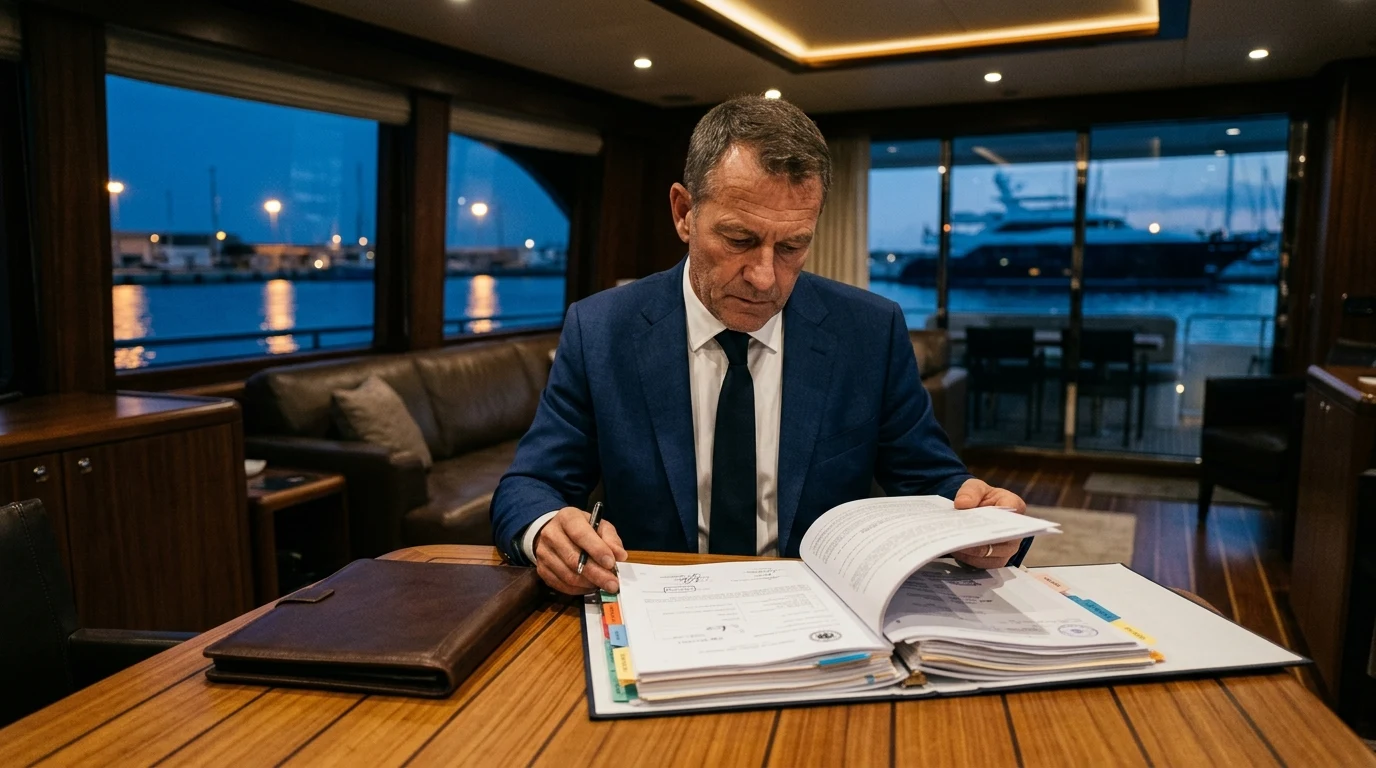
Quick Summary
- ✓Yacht broker liability does not end at closing. Disclosure-based claims can be brought years after a transaction under general maritime law, state broker statutes, and contract claims.
- ✓The most common post-sale dispute is not a hidden defect itself. It is a disagreement about what the broker disclosed, when, and in what form.
- ✓As-is clauses do not block fraud, misrepresentation, or unfair-trade-practice claims. A documented disclosure trail does the work the as-is clause cannot.
- ✓A structured digital handover record — timestamped, transferred to the buyer at closing, and retained by the broker — converts a memory contest into a documentation contest, and brokers consistently win documentation contests.
- ✓OwlMar's broker handover wizard creates this record automatically and gives both parties a verifiable copy at the moment of transfer.
A broker I have worked with for years called me last spring about a sale he had closed thirty-one months earlier. The buyer's attorney had sent a demand letter alleging that the generator on a 78-foot motor yacht had failed because of a known issue the broker should have disclosed. The buyer wanted the cost of the rebuild, the lost charter weeks, and the legal fees. The number on the letter was just under $180,000.
The broker had done nothing wrong. The seller had serviced the generator on schedule. The pre-purchase survey had not flagged it. The broker had no reason to suspect a problem.
But that is not what the letter was arguing. The letter was arguing the broker should have provided more complete service history at handover, and that the buyer had not received documentation of a generator service from eighteen months before the closing.
Here is the part that mattered. The broker had used a structured handover workflow on that sale. Every document the seller provided had been logged, timestamped, and transferred to the buyer through the platform. He could pull up the full handover record, including the generator service entry the buyer's attorney claimed had been omitted. The entry was there, dated four months before closing, with a PDF of the invoice attached.
The demand letter went away within two weeks.
That outcome is not unusual when the documentation exists. It is exceptionally unusual when it does not.
What Post-Sale Liability Actually Looks Like
Yacht broker liability is not a single doctrine. It is a stack of overlapping obligations that can be invoked independently depending on the jurisdiction and the facts. The Yacht Brokers Association of America has catalogued the principal causes of action a buyer can bring against a broker in Florida alone:
- Breach of contract
- Breach of warranty
- Violation of the Magnuson-Moss Warranty Act
- Negligent misrepresentation or omission
- Breach of fiduciary duty
- Fraud in the inducement or fraudulent concealment
- Deceptive and unfair trade practices
Other jurisdictions follow similar patterns. California's Yacht and Ship Brokers Act imposes statutory duties on licensees, and a buyer injured by fraud or willful negligence can file against the broker's bond. New York and the Northeast generally rely more heavily on common-law fiduciary principles. The MYBA contract framework used across Europe has its own disclosure architecture.
The window for these claims is rarely short. Under general US maritime law, personal injury claims carry a three-year statute of limitations, and many state-law claims tied to a yacht sale can be brought four years or longer after the transaction. Several jurisdictions apply a discovery rule that effectively extends the window from the date of discovery rather than the date of sale. A broker who assumes liability ends at closing is operating on an assumption the case law does not support.
The Disclosure Question Is Where Brokers Get Hurt
The single largest category of post-sale broker disputes is non-disclosure of material facts. The most-cited precedent in the brokerage community is the Ohio case in which a court ordered a brokerage to pay a buyer $1.9 million for failing to disclose that the powerboat sold had been significantly damaged in a grounding and inadequately repaired. The court characterised the withholding as "particularly gross and egregious" and called it "a pattern of conduct that was designed to sell a vessel to an unsuspecting buyer, regardless of its defects."
That case sits at the extreme end. The far more common pattern is mundane: the buyer discovers something — a partial repair, a lapsed certification, a recurring fault — and argues the broker should have surfaced it. The broker may have asked the seller. The broker may even have a vague memory of mentioning it. But the broker cannot prove either point.
In a deposition, the question is not whether the broker is honest. The question is what the record shows. A broker testifying from memory two years after a closing is a broker losing a credibility contest with a buyer's attorney who has organised exhibits.
The defensible position is documentary: the broker can demonstrate exactly what was asked of the seller, exactly what the seller represented, exactly what was disclosed to the buyer, and exactly when each transfer occurred. That position is reachable. It just requires a structured workflow rather than an email chain.
Why As-Is Clauses Do Less Than Brokers Think
Most yacht sale agreements include an as-is clause. Many brokers treat it as a complete shield against post-sale claims. It is not.
Florida law is explicit that an as-is clause does not limit broker liability for fraud, negligent misrepresentation, or violations of deceptive and unfair trade practices statutes. Other states reach similar results through different reasoning. The MYBA Memorandum of Agreement also assumes good-faith disclosure as a foundation, and English courts have not been hospitable to as-is defences where the broker had access to information the buyer did not.
The clause does real work in limiting implied warranty claims. It does very little work on the disclosure claims that produce most post-sale broker exposure. The work that the as-is clause cannot do has to be done by a documented disclosure record.
What a Documentation Defence Actually Requires
A handover record that protects a broker years after the fact has to do four things. It has to be complete, structured, timestamped, and transferable.
Complete means every category of material information is captured in one place: the maintenance history the seller provided, the equipment inventory, the safety and class certificates, the manuals and warranties, the crew records if applicable, the insurance status, and any known issues the seller disclosed. A buyer cannot later argue they did not receive what is plainly in the record.
Structured means the buyer can move through the record without the broker's help. A 200-megabyte zip file of unsorted PDFs is not a defence. A categorised, indexed handover with each document tagged to the part of the vessel it covers is. The buyer's surveyor or attorney can see exactly what was provided, and the structure itself demonstrates a professional standard of care.
Timestamped means every document carries a verifiable date of transfer. If the buyer alleges they did not receive the generator service invoice, the record shows it was transferred on a specific date through a specific channel, with the buyer's confirmation logged. Memory becomes irrelevant.
Transferable means the buyer receives a copy they retain independently. A handover record that lives only in the brokerage's server is fragile. One that lives in the buyer's own ownership platform is durable. If a dispute arises, both sides have the same record, and the conversation moves from "what did you send me" to "what do these documents actually show."
A traditional email-and-PDF handover hits maybe one of these four criteria, and only on a good day. A structured platform handover hits all four by default.
Where OwlMar Sits in This
OwlMar's broker handover wizard was built around this problem. When a broker initiates a handover, the seller's existing vessel records — maintenance history, service receipts, equipment inventory, document expiry dates, photo library — are packaged into a structured handover record. The buyer accepts the handover into their own OwlMar account, and the transfer is timestamped at the moment of acceptance. Both sides retain identical, dated copies.
The broker also retains a transaction record showing what was disclosed, when it was disclosed, and the buyer's acknowledgement. If a dispute surfaces six, twelve, or thirty months later, the record is intact and accessible. It is the same record the broker had at closing, not a reconstruction from memory or a search through an old inbox.
We built this for brokers who already understand the liability picture and want a workflow that matches the standard of care they already practice. It is not a replacement for legal advice, a maritime attorney's review of contract language, or a brokerage's own E&O policy. It is the documentation layer that makes those other defences usable. See the broker handover overview on the /yacht-brokers page for a walkthrough of how the workflow runs end to end.
Brokers evaluating whether the workflow fits their practice can also use the Help Co-Pilot widget in the application to ask handover-specific questions — covering everything from how transfers work to what documents the wizard packages by default.
A Final Note on Risk Posture
The brokers I have watched build durable practices over twenty-plus years share a common posture. They do not assume liability ends at closing. They build documentation discipline into the sale itself so that, three years later, the question of what happened has a defensible answer. They treat the handover not as an administrative formality but as the foundation of their professional defence.
That posture costs almost nothing in workflow time when the tooling is built for it. It costs an enormous amount in legal fees, settlement exposure, and reputational damage when it is missing.
The demand letter that arrives thirty months after closing is not the moment to start the documentation. It is the moment the documentation either exists or it does not.
This article is informational and does not constitute legal advice. Brokers facing a live claim or building a compliance program should consult a maritime attorney licensed in the relevant jurisdiction.

Written by
OwlMar Team
Maritime Technology Experts
The OwlMar team brings decades of combined experience in maritime operations, marine engineering, and software development. We write from real-world experience managing vessels from 30ft cruisers to 100m+ superyachts.
Ready to Simplify Your Yacht Management?
OwlMar helps owner-operators track maintenance, manage costs, and get AI-powered diagnostic assistance. Start your free trial today.
Request a DemoRelated Articles
Manual vs Platform Yacht Handover: The Real Differences
A yacht handover platform changes auditability and dispute risk, not closing-day speed. Honest comparison of manual versus platform handovers for brokers.
Yacht Broker Software in 2026: Listings, Deals, and Handovers
An honest map of yacht broker software in 2026 — listing CRMs, deal tools, PMS, and handover platforms — and the gap most brokerages still close by hand.
IDEA Yacht Alternative: An Honest Fleet Comparison
An honest IDEA Yacht alternative for fleet and superyacht operators: where IDEA's 25-year incumbency genuinely wins, and where OwlMar closes the gap.