Manual vs Platform Yacht Handover: The Real Differences
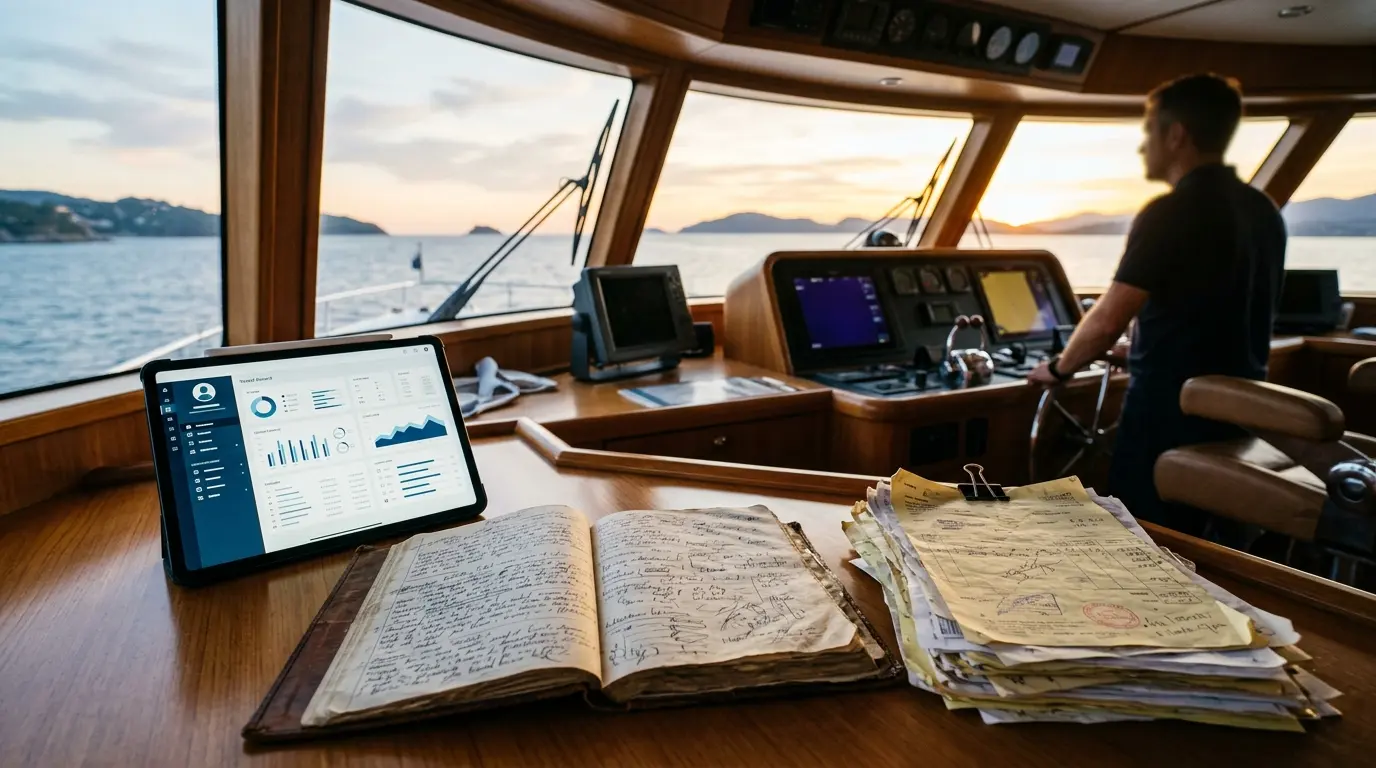
Quick Summary
- ✓Manual handovers still work for straightforward sales between known parties — they fail when documents are queried months later
- ✓A platform-assisted handover is not faster on closing day; the time saving sits in the weeks leading up to it
- ✓Auditability is the real difference — a tamper-evident timeline beats a folder of PDFs the moment a dispute arises
- ✓Platforms shift the broker from document custodian to transaction facilitator, reducing post-sale call volume
- ✓A platform-assisted handover is rarely the lowest-cost option; it is usually the lowest-risk one
A broker in Palma was preparing for a closing on a 28-metre motor yacht last spring. Nine-year ownership, clean survey, finance arranged, closing the following Friday.
On the Tuesday before closing, she began assembling the handover. By Thursday evening she had collected forty-three PDF invoices in three different naming conventions, a paper logbook still in the owner's apartment in Geneva, the original Volvo warranty pack from the yard in La Spezia, a USB drive of refit photographs, and an email chain about a 2024 stabiliser repair that nobody could quite reconstruct.
The handover happened. The buyer received a 6 GB folder, a binder, the USB drive, and a verbal walkthrough. Everyone signed. The deal closed.
Eleven months later, the buyer's surveyor flagged a discrepancy on the stabiliser service history during a pre-insurance audit. The solicitor wrote to the broker. The broker wrote to the seller's management company, which had since changed staff. Nobody could produce the exact email chain. The dispute did not become litigation, but it consumed four weeks of professional time and a small good-faith credit from the broker's commission.
This is the case for evaluating a yacht handover platform — not on closing day, but on the day a question is asked eleven months later.
What a Manual Handover Actually Looks Like
A traditional yacht handover is not a single moment. It is a workflow that runs across the four to eight weeks before closing, conducted predominantly by email and supplemented by physical document collection from the vessel itself.
The standard manual handover package, prepared well, includes:
- A maintenance history compiled from invoices, work orders, and the captain's logbook
- The equipment register, usually maintained as a spreadsheet by the engineer or management company
- Class and flag-state documents collected from the relevant registries
- Crew employment records and certifications, where applicable
- Operating manuals, warranty documentation, and OEM service records
- Survey reports, sea-trial records, and pre-purchase inspection documentation
Assembled into a PDF folder or a physical binder, this is a credible professional output. For a private sale between parties who already know each other, with a short and well-documented vessel history, a manual handover prepared by an experienced broker is genuinely sufficient.
The manual approach has real strengths worth naming. It requires no platform adoption, no subscription cost, and no workflow change. The format is universal — every buyer, surveyor, and solicitor knows what to do with a folder of PDFs. And for a broker handling fewer than ten transactions a year, the time investment is absorbed into commission economics that already account for it.
What manual handovers cannot do is produce a verifiable record of what was actually transferred, when, and to whom.
What a Platform-Assisted Handover Changes
A platform-assisted handover is not a different document set. It is the same documentation maintained continuously, in one structured location, throughout the seller's ownership — then transferred at closing through a defined export and acknowledgement workflow.
The closing-day experience is broadly similar. The buyer receives access to the maintenance history, equipment register, compliance records, and crew documentation. The broker oversees the transfer. The seller signs off. The differences are everywhere except in that closing-day moment.
Preparation time compresses
A typical manual handover for a mid-size superyacht consumes six to twelve hours of professional time across the broker, seller, and management company — chasing invoices, reconciling the equipment list, confirming a service record from two refits ago. A platform-assisted handover compresses that to roughly one to two hours of review, because the records have been maintained continuously rather than assembled retrospectively. The work was done in real time, by the people who did the maintenance.
Auditability becomes binary
In a manual handover, the question "did the buyer receive this document" is answered with a signed checklist and trust. In a platform-assisted handover, the question is answered with a time-stamped access log. The buyer's first view of the stabiliser service history is recorded. The acknowledgement is recorded. If a dispute arises eleven months later, the record exists and is the same record both parties retain.
This is the dispute-resolution case. A platform handover is not more pleasant on closing day. It is more defensible on the day a question is asked.
Documents stop being a custodian problem
In a manual workflow, the broker is the document custodian — temporarily, but practically. If a document goes missing, the broker is expected to know where it went. In a platform workflow, the broker is the transaction facilitator. The documents live on the platform, accessible to whoever has been granted permission, indefinitely.
This is a structural change in the broker's exposure. Post-sale call volume drops because the buyer can look up the answer themselves. The broker's role becomes higher-value and less administrative.
The audit trail covers crew transitions
When a vessel changes hands, the crew often does too. STCW certifications, employment agreements, and the practical knowledge of who-knows-what about which system are real handover assets that paper workflows rarely address well. A platform-assisted handover treats crew records as first-class data and transfers them with the same audit trail as the engineering documentation.
Where Manual Still Wins
A platform-assisted handover is not the right answer for every transaction. Three situations where manual remains appropriate:
Short-history sales. A two-year-old vessel with one owner and a single management company that has its records in order can be handed over manually with no real loss. Platform value compounds with vessel age and ownership history; on a young vessel the gap is small.
Trusted-party transactions. When the same broker has represented the seller for years and the buyer is a known repeat client, the relationship absorbs the auditability gap. Dispute risk is low because the parties trust each other.
Sellers with strong existing systems. A management company that already maintains complete digital records in its own system can produce a high-quality manual handover. The platform value here is incremental, not transformational.
A platform-assisted handover is rarely the lowest-cost option for the seller. It is usually the lowest-risk option for the broker.
Choosing Vessel Handover Software a Broker Can Actually Use
Not every yacht management platform is built around the broker's workflow. The handover-specific features that matter are:
- Export of the complete vessel record as a structured handover package, not a folder dump
- Time-stamped buyer acknowledgement of received documents
- Permission boundaries that let the seller revoke access cleanly at closing
- A broker dashboard that surfaces incomplete documentation before closing, not after
- Continuity of the buyer's access after the transaction, without the seller's involvement
OwlMar's broker tools are built around this workflow specifically. The handover wizard packages the maintenance history, equipment register, compliance documentation, and crew records into a single structured transfer, with the audit trail preserved on both sides.
For brokers weighing whether a platform-assisted handover fits their practice, the Help Co-Pilot widget on the OwlMar platform answers broker-specific workflow questions without requiring a full account signup. It is the lowest-friction way to see how the handover wizard handles a particular transaction shape before committing to a trial.
The Palma broker's story does not need to repeat itself.
Related Articles
- The Yacht Broker's Handover Checklist: What Buyers Actually Need on Day One — the documentation layer of a professional handover
- Selling Your Yacht? How Digital Maintenance Records Can Add 10-15% to Your Asking Price — the resale-value case for documented vessels
- Paper Logbooks to AI: Modernize Yacht Records — why paper persists and what changes when records go digital
- B2B Yacht Management Platforms for 2026 — what enterprise buyers expect from a yacht management platform
Sources

Written by
OwlMar Team
Maritime Technology Experts
The OwlMar team brings decades of combined experience in maritime operations, marine engineering, and software development. We write from real-world experience managing vessels from 30ft cruisers to 100m+ superyachts.
Ready to Simplify Your Yacht Management?
OwlMar helps owner-operators track maintenance, manage costs, and get AI-powered diagnostic assistance. Start your free trial today.
Request a DemoRelated Articles
IDEA Yacht Alternative: An Honest Fleet Comparison
An honest IDEA Yacht alternative for fleet and superyacht operators: where IDEA's 25-year incumbency genuinely wins, and where OwlMar closes the gap.
Helm Connect Alternative: No More Double Data Entry
An honest Helm Connect alternative for superyacht fleet managers: where Helm is stronger, where its yacht-native gap starts, and what double entry costs.
OwlMar (formerly YachtWyse) vs Seazone: Charter Management Software Compared
Side-by-side comparison of OwlMar and Seazone yacht management software. Find out which platform fits your charter operation, fleet, or owner-operator needs in 2026.