Superyacht Operating Costs Per Year: A Full Budget Breakdown
Quick Summary
- ✓As a working rule, a superyacht's annual operating cost lands near 8-12% of its market value. A 30m (98ft) yacht worth roughly $10M runs close to $1.1M per year in cash before depreciation.
- ✓Crew is the largest single line on the page — 30-40% of the operating budget on most vessels. It is a function of headcount, and headcount is driven partly by MLC rest-hour rules, not owner preference.
- ✓A 50m (164ft) yacht does not cost twice a 30m. Crew alone roughly triples to 13-16 people across captain, chief officer, engineers, chief stewardess, interior, deck, and galley, pushing cash running cost past $3.6M a year.
- ✓Depreciation is the cost with no invoice. On a $10M yacht it can exceed the entire cash operating budget, and it only becomes visible at resale.
- ✓The same capital in an index fund returning roughly 10% a year would generate about $1M annually. Set against the vessel's carrying cost, ownership represents close to $2M a year in combined cash burn and foregone return before the hull loses a cent.
There is a figure that reframes every superyacht purchase, and it is not the asking price. It is the annual cost of holding the vessel measured against what the same capital would do somewhere else. Park $10 million in an index fund tracking the S&P 500, and at the long-run historical return of roughly 10 percent a year, that capital generates about $1 million annually without a single phone call. Put the same $10 million into a 30-metre motor yacht, and the vessel will cost close to $1.1 million a year to operate before it loses a cent to depreciation. The owner who chooses the yacht is not spending $1.1 million a year. In economic terms, the owner is roughly $2 million a year worse off, every year, and that gap compounds.
This is not an argument against ownership. It is the starting point for owning with clear eyes. A superyacht is a possession, not an investment, and the professionals who run these vessels — captains, chief engineers, and fleet managers — are the people who see the real numbers arrive month after month while the brokerage brochure quietly recedes. What follows is the honest annual budget for two representative vessels: a 30-metre (98-foot) yacht and a 50-metre (164-foot) yacht, itemised line by line, with the categories that budgets most often understate given their proper weight.
The figures below are representative industry ranges, not a quote for any specific hull. Actual costs move with cruising region, flag, age, build quality, and how hard the vessel is run. The structure, however, holds across the fleet.
The Rule That Gets a Superyacht Budget Roughly Right
Before the line items, the shape of the whole. Across the industry, a serviceable planning rule is that a superyacht's annual running cost lands near 8 to 12 percent of its market value each year. The percentage climbs on older vessels, on hard-run charter yachts, and on anything with a complex refit history; it eases on newer, well-documented vessels berthed in lower-cost regions.
For a 30-metre yacht with a market value near $10 million, that rule puts the annual cash operating cost close to $1.1 million. For a 50-metre yacht valued near $25 million, it points toward $2.5 million and up, and in practice a well-used 50m frequently runs higher once crew and refit reserves are counted honestly. The rule is a sanity check, not a substitute for a real budget. What it gets right is the order of magnitude that surprises first-time owners: the cost of running the vessel each year is a meaningful fraction of the cost of buying it.
The rest of this guide takes that single percentage apart and shows where every point of it goes.
A 30-Metre Superyacht: The Annual Operating Budget
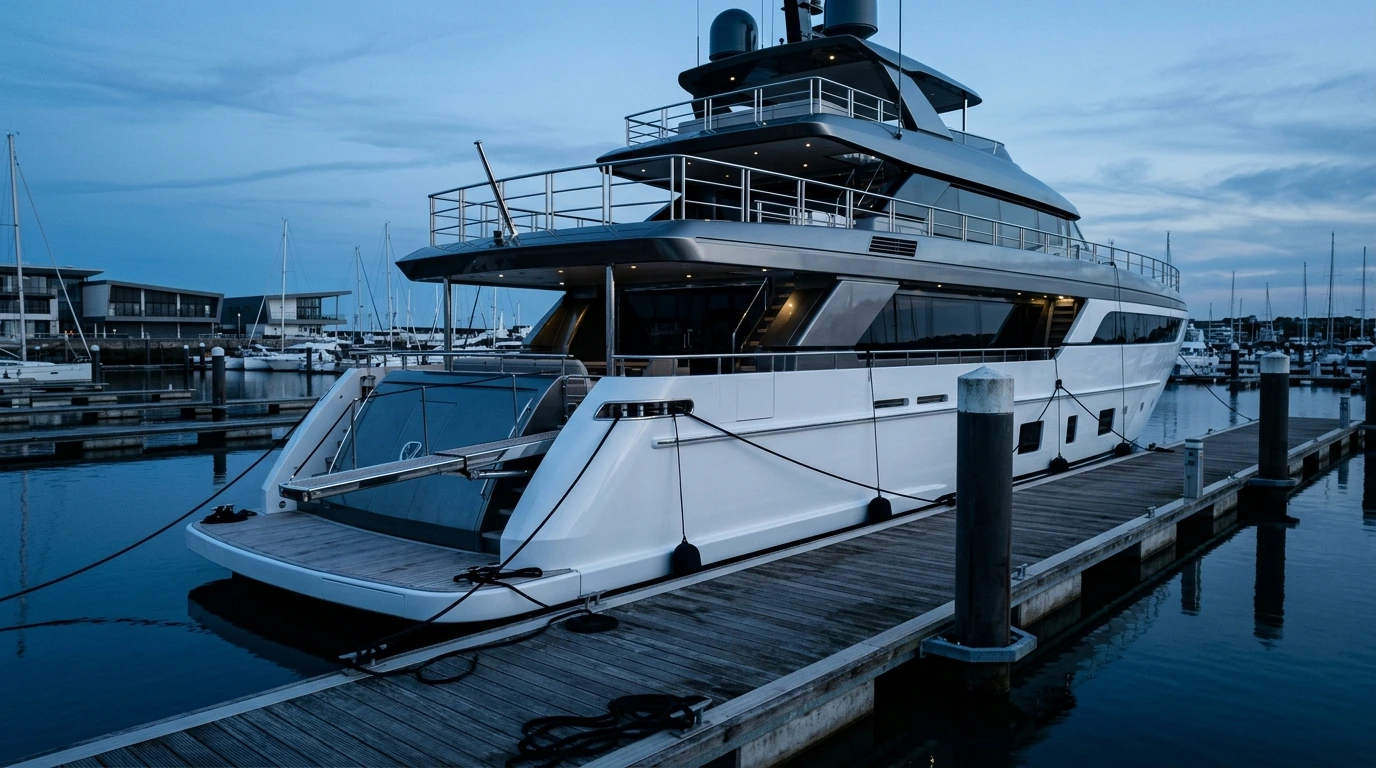
A 30-metre (98-foot) motor yacht is a substantial vessel — professional crew, commercial-grade systems, and an operating rhythm closer to a small ship than to a private boat. Here is a representative full-year operating budget, itemised.
| Cost category | Annual cost (30m / 98ft) | Share of cash budget |
|---|---|---|
| Crew (salaries, travel, training, benefits) | $400,000 | 36% |
| Maintenance, servicing & refit reserve | $180,000 | 16% |
| Marina & berthing | $150,000 | 14% |
| Fuel (main engines, generators, tenders) | $120,000 | 11% |
| Insurance (hull, machinery, P&I) | $90,000 | 8% |
| Management & administration | $60,000 | 5% |
| Provisioning, interior & consumables | $40,000 | 4% |
| Communications & IT (satellite, onboard networks) | $25,000 | 2% |
| Flag, registration, class & compliance | $30,000 | 3% |
| Total annual running cost (cash) | ~$1,095,000 | 100% |
Nine categories, one number near $1.1 million, and not a dollar of it spent on the purchase or on depreciation. Each line rewards a closer look, because the ones owners underestimate are rarely the ones they expect.
Crew, Maintenance, and Marina: The Top Three
The three largest lines — crew, maintenance, and marina — account for roughly two-thirds of the cash budget, and each behaves differently.
Crew is covered in its own section below, because it is the largest number on the page and the least discretionary.
Maintenance, servicing, and the refit reserve at $180,000 is the line that punishes optimism. It covers routine servicing, the annual haul-out and antifouling, class survey work, spares, and — the part most first-year budgets omit — a reserve against the major refit that arrives on a five-to-ten-year cycle. A single generator overhaul, stabiliser service, or paint correction can consume a year's routine allowance on its own. Treating maintenance as "what broke this year" rather than a funded reserve is the most common way a superyacht budget goes wrong. This is also where disciplined record-keeping pays for itself: a vessel with a complete, searchable service history spends less on diagnosis, defends its resale value, and avoids paying twice for work nobody logged the first time.
Marina and berthing at $150,000 is more variable than any other line. A home berth in a mid-tier Mediterranean or Florida marina is one number; a premium berth in Monaco, Antibes, or Porto Cervo during the summer season is a different order of magnitude entirely, with peak-season nightly rates that can reach four figures per night for a yacht of this length. Berthing contracts also carry escalation clauses that quietly raise the figure year over year — a mechanism worth understanding in detail, covered in our breakdown of hidden marina fees and escalation clauses.
Fuel, Insurance, and the Lines That Look Small
Fuel at $120,000 is a usage number, not a fixed one. A yacht that crosses oceans burns far more than one that moves between summer and winter berths with a handful of guest trips. The figure covers main engines, generators running around the clock at anchor, and the tenders and toys that guests expect to find fuelled and ready.
Insurance at $90,000 — hull, machinery, and protection and indemnity cover — typically runs near 1 percent of insured value for a well-found private yacht, moving up with cruising area, crew experience, claims history, and commercial use. It is one of the more predictable lines, which is precisely why it should be reviewed annually rather than renewed on autopilot.
The remaining lines look small individually and add up quickly. Management and administration at $60,000 covers the shore-side management company that handles accounting, crew payroll, ISM administration, and technical oversight. Provisioning and interior consumables at $40,000 covers everything from galley stores to interior refresh. Communications and IT at $25,000 covers satellite connectivity and onboard networks that guests now treat as non-negotiable. Flag, registration, class, and compliance at $30,000 covers registry fees, class society survey administration, and the documentation load that keeps the vessel legal to operate. Together these four "small" lines are $155,000 — more than the fuel bill.
Crew: The Single Biggest Number on the Page
Crew is 30 to 40 percent of a superyacht's operating budget on almost every vessel, and on the 30-metre above it is 36 percent — $400,000 across five to seven people. That figure is not only salaries. It is recruitment and travel, ongoing STCW and specialist training, uniforms, crew insurance and medical cover, and the flights that rotate crew on and off through the season.
The point professionals understand and buyers often do not is that crew headcount is only partly a matter of preference. The Maritime Labour Convention 2006 sets minimum standards for hours of rest, and those standards act as a practical floor on how few people can safely run a vessel through an active program. A yacht cannot legally or safely operate a full charter season, with guests aboard and the vessel moving, on a skeleton crew working around the clock. Rest-hour compliance forces a larger roster, and a larger roster is the single biggest reason the crew line climbs as vessels get bigger. Crew cost, in other words, is regulated cost as much as it is chosen cost.
This guide keeps crew at the line-item level deliberately; the full picture of crew salaries, benefits, rotation structures, and package benchmarks is a subject in its own right. What matters for the budget is the proportion: on any honest superyacht plan, crew is the number every other line is measured against.
Scaling Up: A 50-Metre Superyacht
A 50-metre (164-foot) yacht is not a larger version of a 30-metre — it is a different operation. The most visible change is crew. Where a 30m runs with five to seven, a 50m typically carries 13 to 16, organised into a clear shipboard hierarchy.
| Department | Roles | Typical count |
|---|---|---|
| Command | Captain | 1 |
| Deck | Chief Officer (first mate), Bosun, Deckhands | 4-5 |
| Engineering | Chief Engineer, Second Engineer | 2 |
| Interior | Chief Stewardess, Stewards/Stewardesses | 4-5 |
| Galley | Head Chef, Sous Chef / Crew Cook | 2 |
That structure is what pushes the crew line from $400,000 to roughly $1.5 million. It is also why rest-hour rules matter more, not less, at this size: a vessel with guests aboard, a full interior service, and an engine room that must be watched cannot compress those roles without breaching the rest standards that keep the operation legal and safe. Here is the scaled annual budget.
| Cost category | Annual cost (50m / 164ft) |
|---|---|
| Crew | $1,500,000 |
| Maintenance, servicing & refit reserve | $600,000 |
| Marina & berthing | $500,000 |
| Fuel | $400,000 |
| Insurance | $250,000 |
| Management & administration | $150,000 |
| Provisioning, interior & consumables | $120,000 |
| Communications & IT | $60,000 |
| Flag, class & compliance | $90,000 |
| Total annual running cost (cash) | ~$3,670,000 |
Crew here is 41 percent of the budget — the same 30-to-40 percent proportion that held on the 30m, scaled up with the vessel. Every other line grows too, but none as steeply as crew, and none is as fixed. A 50-metre yacht that is genuinely used, rather than kept alongside, comfortably exceeds $3.6 million a year in cash operating cost. And that figure, like the 30m budget before it, still excludes the largest cost of all.
What Moves the Budget Most
Two vessels of identical length can run several hundred thousand dollars apart in a year, and the reasons are consistent enough to plan around. Three variables do most of the work.
The first is usage intensity. A yacht that crosses oceans, runs a full summer season with guests aboard, and moves between hemispheres burns fuel, accumulates engine hours, and wears its interior at a pace a lightly used vessel never approaches. Usage drives fuel directly and maintenance indirectly, because engine hours and guest cycles pull the next major service forward.
The second is region. A Mediterranean summer program built around Monaco, Antibes, and the Balearics carries premium berthing, higher local labour rates, and peak-season surcharges that a vessel based in a lower-cost cruising ground avoids. The same yacht wintering in a working yard rather than a marquee marina saves on the berth and often on the yard rate for refit work carried out in the off-season.
The third is age and condition. A newer, well-documented vessel spends less on unplanned maintenance and holds its insured value better; an older yacht with a thin service history spends more on diagnosis, more on parts, and defends its resale value less effectively. This is where the refit cycle dominates: a major refit landing in a given year can double that year's maintenance line on its own, which is precisely why the reserve exists. A budget that treats these three variables as fixed will be wrong every year. A budget that models them as ranges will be close.
Depreciation: The Cost With No Invoice
Every number above is cash that leaves the account during the year. Depreciation is different. There is no invoice, no monthly statement, no line a manager can point to — and yet on a yacht of this value it is frequently the single largest cost of ownership.
A superyacht loses value steadily through its life, and the rate depends heavily on build quality, brand, condition, and the state of the brokerage market when the owner sells. On a $10 million 30-metre yacht, annual depreciation can run from a few hundred thousand dollars to well over half a million — a figure that can exceed the entire cash operating budget. It becomes visible only once, at resale, which is exactly why it is the cost owners most consistently underestimate. The same forces that govern how fast any vessel loses value are set out in our analysis of why yachts depreciate and how to slow it.
Fold depreciation back into the picture and the "true cost" of the 30-metre yacht is not $1.1 million a year. It is closer to $1.6 million to $1.8 million a year in combined cash and lost value — before the opportunity cost of the capital is even counted.
The Comparison Owners Rarely Run
Return to the figure this guide opened with, now with the full budget behind it. The 30-metre owner has roughly $10 million tied up in the vessel and spends about $1.1 million a year running it. The same $10 million in a broad index fund, at the long-run historical return of roughly 10 percent a year, would generate about $1 million annually.
Set those side by side. Before the yacht depreciates a single dollar, ownership represents close to $2 million a year — the $1.1 million spent to operate the vessel, plus the roughly $1 million of return the capital is no longer earning. Add depreciation and the annual figure moves past $2.5 million. Over a ten-year hold, the compounding widens the gap into the tens of millions: the index position grows while the vessel consumes cash and sheds value.
None of this is a verdict. Owners buy superyachts for reasons an index fund cannot provide, and that is a legitimate choice made by people who can afford it. The purpose of running the comparison is precision. An owner who understands that the vessel costs roughly $2 million a year in total economic terms makes better decisions about size, usage, charter, and holding period than one who anchored on the running-cost figure alone. This is also the logic behind modelling a full ten-year total cost of ownership rather than a single year: the first-year invoice is the least representative number in the entire exercise.
Can Charter Offset the Cost?
The natural response to a $1.1 million running cost is to put the vessel into charter and let paying guests carry part of the load. Done with realistic expectations, this works — as cost reduction, not as income.
A charter program recovers a portion of the operating budget through booked weeks, but it does not recover all of it, and it adds costs of its own: management commission on gross revenue, higher commercial-rate insurance, accelerated wear from harder use, and the provisioning and readiness standards that paying guests expect. Most managed yachts end up covering a share of their costs rather than turning a profit, and the vessels that genuinely break even are a small minority of the fleet that book far more weeks than the average. Charter is best modelled as a discount on the annual budget, sized honestly, not as a revenue line that makes the yacht pay for itself.
The full economics — break-even week counts, the management fee waterfall, and what commercial use does to insurance and depreciation — are worked through in detail in The Charter Offset Myth. For a superyacht budget, the summary is enough: charter can shift the numbers, but it does not erase them.
Bringing the Numbers Under Control
The difference between a superyacht budget that holds and one that surprises the owner every quarter is rarely the size of the figures. It is visibility. A vessel whose crew costs, maintenance history, fuel burn, insurance renewals, and refit reserves live in one place — rather than scattered across spreadsheets, email threads, and a filing cabinet ashore — is a vessel whose true cost can be seen before it is spent.
That is the operational case for managing a superyacht's cost picture in a single system. OwlMar gives captains, engineers, and fleet managers one place to track maintenance and its costs, store the insurance policies, class certificates, and crew documents in the Digital Ship's Vault with renewal reminders before deadlines lapse, and use Wyse-I to surface maintenance patterns and predictive-maintenance signals before a deferred job becomes a haul-out. When the refit reserve is funded against real service history rather than guesswork, and when the largest lines on the budget are measured rather than estimated, the annual number stops being a surprise.
For teams weighing the operational fit, the Help Co-Pilot on the OwlMar platform answers questions about how the tools map to a specific vessel's workflow without a full account. The budget will still be large — a superyacht is an expensive thing to run, and no software changes that. What it can change is whether the owner sees the number coming.
Related reading:
- Yacht Depreciation Explained: Why Boats Lose Value Fast
- Yacht Total Cost of Ownership: A 10-Year Budget Framework
- Hidden Marina Fees and Escalation Clauses
- The Charter Offset Myth
- OwlMar for Superyachts
Figures in this guide are representative industry ranges for planning purposes, not a quotation for any specific vessel. Actual costs vary with cruising region, flag, vessel age, build quality, and operating intensity.

Written by
OwlMar Team
Maritime Technology Experts
The OwlMar team brings decades of combined experience in maritime operations, marine engineering, and software development. We write from real-world experience managing vessels from 30ft cruisers to 100m+ superyachts.
Ready to Simplify Your Yacht Management?
OwlMar helps owner-operators track maintenance, manage costs, and get AI-powered diagnostic assistance. Start your free trial today.
Request a DemoRelated Articles
Superyacht Crew Cost Per Year: Budgeting for a Full-Time Crew
What a full-time superyacht crew actually costs per year — salaries by role and vessel size, plus the MLC, insurance, training, and turnover costs that never appear on a payroll line.
Fleet-Wide Tide-Aware Anchor Watch for 2026
Fleet anchor watch finally goes shore-side. Tide-adjusted swing radius, fleet dashboards, captain-rotation handover, and audit-grade logs for multi-vessel ops.
Yacht Crew Management Software Guide (2026)
Compare the best yacht crew management software for superyachts in 2026. Certification tracking, MLC compliance, role-based permissions, and fleet oversight.